
Friday, 8 November 2019

Monday, 4 November 2019
PLANNING YOUR PRODUCTION
November is your planning month.
December is your construction month - when you film and edit.
Your planning will be both about concepts - what your film opening is about - and about organization - the processes involved in achieving it. The film opening is worth 60 marks for the planning and construction combined. You can share the tasks.
The TITLE of each post starts with the word PLANNING
PLANNING: INITIAL DEVELOPMENT Mind map plus discussion, decisions & revisions like this one
PLANNING: TREATMENT Topline & Big Question like this one plus extended treatment outline. Emmy winner Ben Tricklebank's treatment for his short Young Man's Game is here. The presentation of the treatment inspired me with its clarity and organization.
PLANNING: MY TARGET AUDIENCE Answer the questions. Some of you are adding images which is great. Add your audience profile, like a 'mood board' of visuals.
PLANNING: AUDIENCE QUESTIONNAIRE Google Forms like this one
PLANNING: CHARACTERS Characters with images + outfits, with a focus on the representation of social groups and issues, such as stereotypes / anti-stereotypes One Pinterest board for characters, one for issues Like these and this one
PLANNING: CASTING in a Slideshare like this
PLANNING: CHARACTER DEVELOPMENT HOT SEATING Interview your protagonist in role Video /audio like this video interview or this audio version
PLANNING: PROPS LIST like this one
PLANNING: LOCATIONS photos of recces + internet images Collage like PicMonkey, Fuzl like this one
PLANNING: STORYBOARD Hand drawn images + arrows + notes like this
PLANNING: SHOT LIST Follow the format issued Word Document like this one
PLANNING: CALL SHEET Follow the format issued Word Document with images like this one
PLANNING: RISK ASSESSMENT Follow the format issued Word Document like this one


December is your construction month - when you film and edit.
Your planning will be both about concepts - what your film opening is about - and about organization - the processes involved in achieving it. The film opening is worth 60 marks for the planning and construction combined. You can share the tasks.
The TITLE of each post starts with the word PLANNING
PLANNING: INITIAL DEVELOPMENT Mind map plus discussion, decisions & revisions like this one
PLANNING: TREATMENT Topline & Big Question like this one plus extended treatment outline. Emmy winner Ben Tricklebank's treatment for his short Young Man's Game is here. The presentation of the treatment inspired me with its clarity and organization.
PLANNING: MY TARGET AUDIENCE Answer the questions. Some of you are adding images which is great. Add your audience profile, like a 'mood board' of visuals.
PLANNING: AUDIENCE QUESTIONNAIRE Google Forms like this one
PLANNING: CHARACTERS Characters with images + outfits, with a focus on the representation of social groups and issues, such as stereotypes / anti-stereotypes One Pinterest board for characters, one for issues Like these and this one
PLANNING: CASTING in a Slideshare like this
PLANNING: CHARACTER DEVELOPMENT HOT SEATING Interview your protagonist in role Video /audio like this video interview or this audio version
PLANNING: PROPS LIST like this one
PLANNING: LOCATIONS photos of recces + internet images Collage like PicMonkey, Fuzl like this one
PLANNING: STORYBOARD Hand drawn images + arrows + notes like this
PLANNING: SHOT LIST Follow the format issued Word Document like this one
PLANNING: CALL SHEET Follow the format issued Word Document with images like this one
PLANNING: RISK ASSESSMENT Follow the format issued Word Document like this one


TV DRAMA: THE GOOD COP
A brief analytical task. The Good Cop is available on Netflix.
A man is murdered by a giant white bunny rabbit. Tony Sr. meets a beautiful woman with an ulterior motive. Vasquez has her first case as a detective.


Section A [50]

A man is murdered by a giant white bunny rabbit. Tony Sr. meets a beautiful woman with an ulterior motive. Vasquez has her first case as a detective.


Section A [50]
- Discuss the ways in which the extract from constructs meaning through the following: •camera shots, angles, movement and composition • editing • sound • mise-en-scène.
- Extract details: The Good Cop: What Is The Supermodel's Secret?' – S1; E4 Clip duration: 5.0 Start point: opening End point: below

Saturday, 2 November 2019
PLANNING: AUDIENCE QUESTIONNAIRE
We design and distribute an individual audience questionnaire to investigate your target audience's preferences.
The audience questionnaires is tailored to our own film production work.
We use Google Forms, upload to the platform of our choice then present the data both in graphical form and in words, as you have asked questions that yield both quantitative and qualitative data.
Make your blog post outlining what you have done:


SAMPLE AUDIENCE QUESTIONNAIRE: SHORT FILMS
We use Google Forms, upload to the platform of our choice then present the data both in graphical form and in words, as you have asked questions that yield both quantitative and qualitative data.
Make your blog post outlining what you have done:
- use the title RESEARCH: AUDIENCE QUESTIONNAIRE
- state that you used Google Forms and why it is so useful
- explain what was the aim of the questionnaire and where you intend to publish it
- comment on the kinds of questions that you asked, drawing attention to the fact that you wanted to research the target audience for the kind of film that you yourself and your production team were planning to make, in particular, the target age group
- add an image of your form as well as the link. Which of the 2 questionnaires below makes a better impression? Have you customised and tested yours before sending it out?


SAMPLE AUDIENCE QUESTIONNAIRE: SHORT FILMS
AUDIENCE QUESTIONNAIRE: FILM
1. What age are you?
Under 35
Over 35
2. What gender are you?
Male
Female
3. Do you watch the trailer before the film?
Yes
No
4. Which of the following influence your choice? Tick any box that applies
News articles
Talk shows
Interviews
reviews
AUDIENCE QUESTIONNAIRE: FILM TRAILERS
1. What genre of films do you prefer? You can pick more than one choice
Action/ adventure
Thriller
Romcom
Horror
Comedy
Animation
Drama
Fantasy
Historical
Literary adaptation
2. Do you tend to watch the trailer before deciding whether to watch a film?
Yes
No
3. Where do you see trailers? Tick all relevant boxes
In cinema
Social media platforms like Twitter, Facebook
Online: iTunes platforms, YouTube or similar
4. If you had to pick only one platform of choice for viewing trailers, which would it be?
In cinema
Social media platforms like Twitter, Facebook
Online: iTunes platforms, YouTube or similar
5. In-cinema trailers are a very successful marketing tool. In your view, which factors make this true? Tick all relevant boxes
Dolby surround sound
Big screen
Genre
Atmosphere (social event)
Other (please specify)
6. We are making the trailer for a feel-good drama. Have you seen any of the following ‘feel-good’ dramas?
Pay It Forward, Forrest Gump, Gifted, The Help
Friday, 1 November 2019
PLANNING: MY TARGET AUDIENCE
Your aim in this post is to follow this path as in the example below.
1. Who is my primary target audience?
2. What kind of films and television are they likely to prefer?
3. What platforms do they choose to watch films and where are they likely to see information about films?
4. What brands do they prefer?
5. What makes my film stand out from the competition?
6 . Why should my audience watch my film? For example: Total Film / Empire / Cinema Scope / Slant / Sight and Sound says: Most powerful psychological thriller since Don't Look Now!

2. What kind of films and television are they likely to prefer?

3. What platforms do they choose to watch films and where are they likely to see information about films?

4. What brands do they prefer?

1. Who is my primary target audience?
2. What kind of films and television are they likely to prefer?
3. What platforms do they choose to watch films and where are they likely to see information about films?
4. What brands do they prefer?
5. What makes my film stand out from the competition?
6 . Why should my audience watch my film? For example: Total Film / Empire / Cinema Scope / Slant / Sight and Sound says: Most powerful psychological thriller since Don't Look Now!
I needed to plan how to reach my target audience. I also needed to know who they were. I had to research age, gender, ethnicity and social class. I also needed to research what their media needs were so that I could produce a product that they will want. Finally, in order to market our movie, I had to know how to reach them. I will show how my research has influenced my planning by answering the question below along with pictures to help support my answers.
I started by studying how brands define audiences to help create my own audience profile for our production. For example I looked at how Sky and NME defined audiences. This helped when I was profiling my audience, as a part of distributing my film I created a Facebook page, and other members of my group created things like an Instagram and Twitter accounts and also a film website. When trying to find out who my audience was I worked out why they enjoy the genre of this film. Why would they want to watch my film? What makes my film different from competing films? And How will my film appeal to the viewing needs of my target audience?
1. Who is my primary target audience?
British, Male and female aged from 15-35 who love sci-fi and adventure films.

2. What kind of films and television are they likely to prefer?
After doing some film research we discovered that the film “Morgan” would seem like a popular movie for our target audience. It’s a story about a bio-generated girl created by human however things didn’t go quite as planned as she ended up turning lethal and dangerous.

3. What platforms do they choose to watch films and where are they likely to see information about films?
Our audience is most likely to enjoy a film in the cinema most likely at an IMAX as they can experience the true richness and quality of it.

4. What brands do they prefer?
As shown below in my mood board, I did some research into some brands that our audience would like. For food, I used places I enjoyed such as SubWay. For clothing, my age group and I agreed that our preferred shops are Palace, Off-White, Nike Etc. Finally, for media, My fellow peers and I all love films like Star Wars (George Lucas) and Morgan (Luke Scott). In addition we are the first film in just under 17 years to solely focus on A.I as the last film to do so was Steven Spielberg's “A.I. Artificial Intelligence” from 2001.

Thursday, 31 October 2019
RESEARCH: AUDIENCE
We make a SlideShare presenting our research on audiences.
We have learned about various approaches and frameworks relating to audiences.
Here is the information on AUDIENCE RESEARCH that we have studied:
1 - AUDIENCE: A KEY CONCEPT
All media texts are produced with an audience in mind - that is to say a group of people who will receive the text and make some sort of sense out of it.
Understanding audience research will help me plan my own production.
So audience is part of the media equation – a product is produced and an audience receives it. Television producers need an audience for their programmes, so they can finance those programmes and make more programmes that the audience likes. Advertisers need an audience who will see or hear their advertisements and then buy the products.
A media text is planned with a particular audience in mind. A television producer has to explain to the broadcasting institution (e.g. BBC or ITV) who is the likely audience for this particular programme.
Are they under 25 years old or older, mainly male or mainly female, what are they interested in? The television audience varies throughout the day and night, and television and radio broadcast for 24 hours, seven days a week. How do we know who is watching or listening at any one time? This is where audience research becomes important.
A media producer has to know who is the potential audience, and as much about them as possible.
My next task is to create / devise / design an audience profile for my own production

The media effects (hypodermic syringe) model is an outdated model, as it positions audience as as passive. It has been replaced by the uses and gratifications model of audience behaviour, which positions audiences as active.


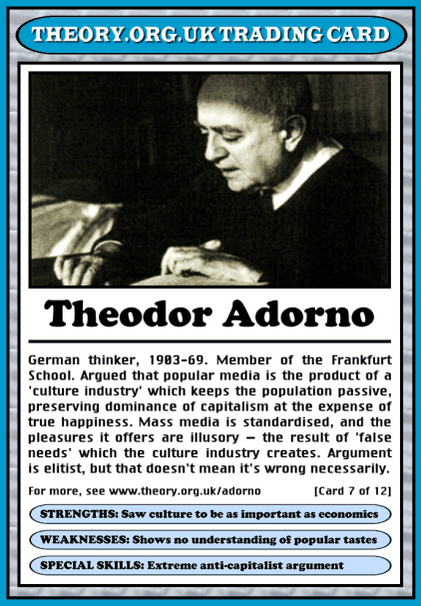 Adorno suggested that culture industries churn out a debased mass of unsophisticated, sentimental products which have replaced the more 'difficult' and critical art forms which might lead people to actually question social life.
" Safety- Linkedin, where you are able to find jobs and networks that could open doors for your career path.
Love/Belonging- Facebook, Google +, where you are able to reconnect and gain relationships, whether it is in the form of acquaintances, friends, lovers or family.
Self-Esteem- Twitter, where you are able to share your experiences, achievements that will help you boost your confidence and gain respect from others.
Self-Realization- Tumblr, Blogspot, Wikipedia, where you are allowed to share your knowledge, interests, inner thoughts and your creativity." (Source https://socialmediaandtheself.wordpress.com/)

The uses and gratifications model of audience behaviour (Blumler and Katz, 1974)
 First, individuals who are opinion leaders, receive messages from the media and pass on their own interpretations in addition to the actual media content. The information does not flow directly from the text into the minds of its audience, but is filtered through the opinion leaders who then pass it on to a more passive audience.
The audience then mediate the information received directly from the media with the ideas and thoughts expressed by the opinion leaders, thus being influenced not by a direct process, but by a two step flow.
This theory appeared to reduce the power of the media, and some researchers concluded that social factors were also important in the way in which audiences interpret texts. This led to the idea of active audiences.
It focuses on the scope in textual analysis for 'negotiation' and 'opposition' on the part of the audience. This means that a text ( a book, film, advert, poster or other creative work) is not passively accepted by the audience but that the reader / viewer interprets the meanings of the texts based on their individual cultural background and life experiences.
Stuart Hall’s encoding / decoding model; dominant (or preferred), negotiated and oppositional readings; why Hall says he studies culture instead of media specifically, and media hegemony. Audiences are no longer considered passive recipients.


We have learned about various approaches and frameworks relating to audiences.
Here is the information on AUDIENCE RESEARCH that we have studied:
1 - AUDIENCE: A KEY CONCEPT
All media texts are produced with an audience in mind - that is to say a group of people who will receive the text and make some sort of sense out of it.
Understanding audience research will help me plan my own production.
So audience is part of the media equation – a product is produced and an audience receives it. Television producers need an audience for their programmes, so they can finance those programmes and make more programmes that the audience likes. Advertisers need an audience who will see or hear their advertisements and then buy the products.
A media text is planned with a particular audience in mind. A television producer has to explain to the broadcasting institution (e.g. BBC or ITV) who is the likely audience for this particular programme.
Are they under 25 years old or older, mainly male or mainly female, what are they interested in? The television audience varies throughout the day and night, and television and radio broadcast for 24 hours, seven days a week. How do we know who is watching or listening at any one time? This is where audience research becomes important.
A media producer has to know who is the potential audience, and as much about them as possible.
My next task is to create / devise / design an audience profile for my own production
2 - AUDIENCE PROFILING
TYPES OF AUDIENCE RESEARCH
Marketing uses audience profiling such as socioeconomics,demographics, psychographics and GEARS to identify different audiences. |
| A common and traditional method of audience research is known as DEMOGRAPHICS. This defines the adult population largely by the work that they do. It breaks the population down into 6 groups, and labels them by using a letter code to describe the income and status of the members of each group. GEARS segments audiences by Gender, Ethnicity, Age, Region,Socio-economic group. |
 |
| PSYCHOGRAPHICS (above) is a way of describing an audience by looking at the behaviour and personality traits of its members. Psychographics labels a particular type of person and makes an assessment about their viewing and spending habits. With cookies tracking consumers' online behaviour when they leave footprints, it is easy for brands to collect data on consumers' spending habits and interests. The advertising agency Young and Rubican invented a successful psychographic profile known as their 4C’s Marketing Model http://www.4cs.yr.com The 4 Cs stand for Cross Cultural Consumer Characterisation. They put the audience into groups with labels that suggest their position in society |
MARS another way of looking at this model : Mainstreamers, Aspirers, Reformers, Succeeders

3 - AUDIENCES AS PASSIVE (4 items)
THE MEDIA EFFECTS MODEL
This approach was originally developed to explain the effects of media that are powerful in positioning audiences, such as television. It supports positions that advocate regulation, as does Gerbner's cultivation theory, which argues that strongly-delivered media messages that are consistently delivered have long-term effects on audiences.The media effects (hypodermic syringe) model is an outdated model, as it positions audience as as passive. It has been replaced by the uses and gratifications model of audience behaviour, which positions audiences as active.
STUDIES USED TO SUPPORT THE EFFECTS MODEL
Bobo doll (Albert Bandura, 1961) We read David Gauntlett's article 10 Things Wrong With The Media Effects Model (1998). In it, he refers to the artificiality of such studies shown by researchers such as Borden (1975).
THE ROLE OF THE MEDIA IN MORAL PANICS Read The Guardian article (screenshot below) Include the article below about how films have been implicated in producing copycat crime.


4 - ADORNO AND THE CULTURE INDUSTRY
For Theodore Adorno, advertising creates false needs that audiences (consumers) passively embraced. Adorno (1903-69) argued that capitalism fed people with the products of a 'culture industry' - the opposite of 'true' art - to keep them passively satisfied and politically apathetic. Adorno suggested that culture industries churn out a debased mass of unsophisticated, sentimental products which have replaced the more 'difficult' and critical art forms which might lead people to actually question social life.
False needs are cultivated in people by the culture industries. These are needs which can be both created and satisfied by the capitalist system, and which replace people's 'true' needs - freedom, full expression of human potential and creativity, genuine creative happiness.
Products of the culture industry may be emotional or apparently moving, but Adorno sees this as cathartic - we might seek some comfort in a sad film or song, have a bit of a cry, and then feel restored again.
5 - AUDIENCES AS ACTIVE (3 items)
Maslow’s Hierarchy of needs is a theory which suggests there are 5 stages people go through in life. The theory says that at each stage we have different motivations that drive us. We use different media, for example, to meet different needs:" Safety- Linkedin, where you are able to find jobs and networks that could open doors for your career path.
Love/Belonging- Facebook, Google +, where you are able to reconnect and gain relationships, whether it is in the form of acquaintances, friends, lovers or family.
Self-Esteem- Twitter, where you are able to share your experiences, achievements that will help you boost your confidence and gain respect from others.
Self-Realization- Tumblr, Blogspot, Wikipedia, where you are allowed to share your knowledge, interests, inner thoughts and your creativity." (Source https://socialmediaandtheself.wordpress.com/)
WHY AUDIENCES CONSUME TEXTS: THE USES AND GRATIFICATIONS MODEL
We look at different models of audience behaviour. Mediaknowall will remind you of what we discussed.The uses and gratifications model of audience behaviour (Blumler and Katz, 1974)
THE TWO-STEP FLOW MODEL
Katz and Lazarsfeld assumes a slightly more active audience. It suggests messages from the media move in two distinct ways. First, individuals who are opinion leaders, receive messages from the media and pass on their own interpretations in addition to the actual media content. The information does not flow directly from the text into the minds of its audience, but is filtered through the opinion leaders who then pass it on to a more passive audience.
The audience then mediate the information received directly from the media with the ideas and thoughts expressed by the opinion leaders, thus being influenced not by a direct process, but by a two step flow.
This theory appeared to reduce the power of the media, and some researchers concluded that social factors were also important in the way in which audiences interpret texts. This led to the idea of active audiences.
6 -RECEPTION THEORY - STUART HALL AND CULTURAL STUDIES
RECEPTION THEORY positions audiences as active.It focuses on the scope in textual analysis for 'negotiation' and 'opposition' on the part of the audience. This means that a text ( a book, film, advert, poster or other creative work) is not passively accepted by the audience but that the reader / viewer interprets the meanings of the texts based on their individual cultural background and life experiences.
Stuart Hall’s encoding / decoding model; dominant (or preferred), negotiated and oppositional readings; why Hall says he studies culture instead of media specifically, and media hegemony. Audiences are no longer considered passive recipients.
 | |
| A 40-year-old man and a 10-year-old girl would not interpret an episode of The Simpsons in the same way. |
7 - EXIT POLLS
The BFI carries out exit polls to assess audience response at film screenings. Here is one example (name, director, date). '71, directed by Yann Demange, 2014
8 - THE ROLE OF THE BBFC
The BBFC looks at issues such as discrimination, drugs, horror, dangerous and easily imitable behaviour, language, nudity, sex, and violence when making decisions. The theme of the work is also an important consideration. They also consider context, the tone and likely impact of a work on the potential audience. Audiences are therefore guided in their viewing; vulnerable audiences are protected. Similar regulation applies to the viewing of video games which are regulated by PEGI


Subscribe to:
Posts (Atom)