Tuesday, 15 October 2019

PRODUCTION PRACTICE: LIVE ACTION FILMING AND EDITING

Filming live action sequence and decisions about your title and credits.

  • The live action piece should 'hook' the audience's attention, making them ask : what happens next?
  • EDIT with the track's lyrics in mind. 
  • Our final piece will be 2 minutes long (like our brief).
  • Arrive at your film title after the table-top sequence, ideally with the words " a door that shouldn't be in front of me".
  • Your live action piece will in some way tie in with this 'door'. It could be a real door or a metaphor - suggesting a barrier, frontier, challenge, block. We have masses of useful doors on site in Claremont from the Walled Garden to the Mansion to the underpass.


Monday, 14 October 2019

PRODUCTION PRACTICE: TITLE SEQUENCE "A WHOLE WORLD IN A TABLE TOP"

Make a blog post that gives an account of your processes and decisions in this shoot and edit. Explain mistakes and successes using articulate reflection. Add photos. 

  • An excellent title sequence is that of To Kill A Mockingbird.
  • We view the title sequence of Delicatessen (1991, Jean-Pierre Jeunet) and study how its inventive camerawork tells a story and sets the theme. 
  • We then use it as inspiration to create an original title sequence in groups by setting up the mise-en-scène using props from our props collection.
  • Our title sequence uses the soundtrack Nostalgia by Emily Barker (the Wallander theme tune).
  • Filming table top - Monday
  • Filming live action - Tuesday
  • Editing of credits, title, sound - Wednesday
  • Discussing your own production treatment - Friday


Make a blog post that gives an account of your processes and decisions. Explain mistakes and successes using articulate reflection. Add photos. 


Saturday, 12 October 2019

RESEARCH: ART OF THE TITLE

Please write three of these in all.
Pick title sequences that are relevant and inspiring.

Write with articulate reflection.
Use your initiative to explore the title sequence: there may be insight below the video section or you may Google the designer / typography.
It is the design features that make it special that you need to notice as well as how its draws in the audience.


Thursday, 10 October 2019

CREATING YOUR TITLE SEQUENCE

Opening and closing Titles (Title Sequences: Function With Form) (Motion Graphic Titling) 

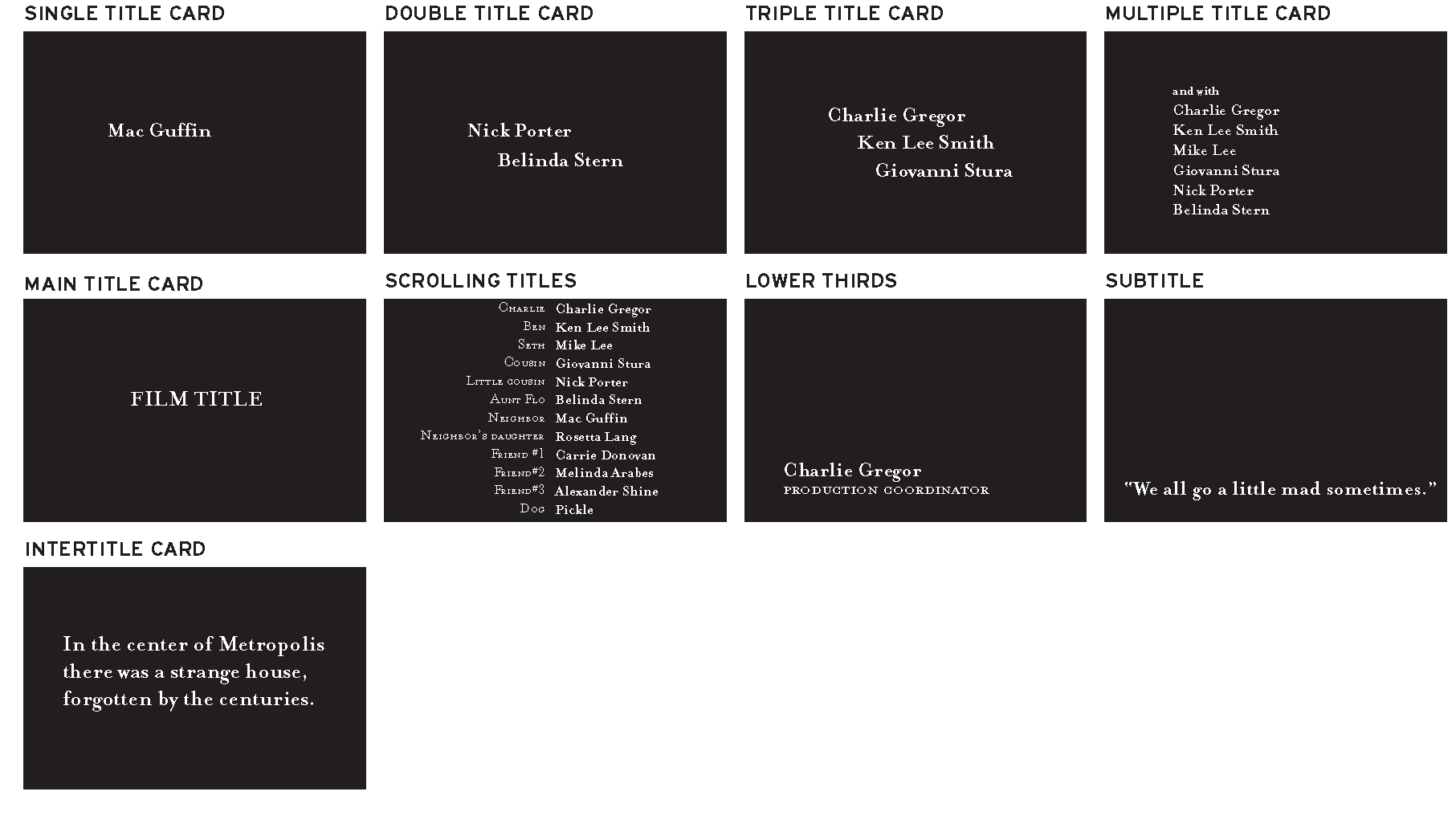
When you are starting to work on your opening titles, you might want to organize the credit information you receive from the client and begin a rough sketch of how the titles will unfold over time (also called animatics). The following terminology and concepts will help you organize your work and facilitate the communication between you and your client. When we talk about a title card, we refer to a screen that displays the credit information of the cast and/or crew. Titles and title cards can be distinguished as follows: •    A single title card contains one name credit. A single title card is typically used in opening titles to display the name of the lead actors and the creative people involved in the movie (director, producers, writer, cinematographer, composer). These are generally referred to as the above-the-line credits.
•    A double title card contains two name credits. A double title card typically is used to display the names of supporting actors and additional creative people involved in the movie.
•    A triple title card contains three name credits. A triple title card is typically used to display the names of additional supporting actors.
•    A multiple title card contains more than three name credits. A multiple title card is typically used to name additional supporting actors or extras.

•    A main title card displays the main title of the movie.
•    Scrolling titles are titles that move sequentially in and out of frame, generally used as end titles. End scrolling titles usually repeat the credits of the opening titles (the talent credits of the opening titles are reorganized either in order of appearance or alphabetically) and then display the below-the-line full crew and cast credits: the special effects, props, soundtrack, equipment and location rentals, film stock, and so on. A title designer can create the design and layout of the text blocks, but if digital scrolling titles are needed (as opposed to a film-out), some companies in Hollywood specialize in digital scrolling titles that avoid flickering type and look nice and smooth.
•    A lower third is a title placed on the lower-third of the screen (although there might be other screen placements you could consider), generally used to display the information—name and title—of a person being interviewed or a location.
•    Subtitles are titles placed on the lower-third part of the screen (or sometimes on the top of the screen to avoid covering relevant information on-screen or previously existing lower thirds). These are generally used to translate dialogue in another language.
•    Intertitles are title cards that display the time, place, prologue, or quotes. In silent films, an intertitle is often used to convey minimal dialogue or information that can’t be deduced from the talent’s body language or the scene’s settings.
Title card examples.
Figure 1.3 Title card examples.
Depending on the type of movie you are working with (home movie, independent flick, Hollywood movie, or something else), the order in which the credits in opening and closing titles appear on-screen and their font size, especially in large-budget productions, are greatly determined by the talent’s contracts, union contracts, and industry conventions. The designer will have very little (if any) say in that. For example, a clause in a talent’s contract might dictate that his credit shouldn’t be in a smaller font size than the one of the main title card. A different clause in another talent’s contract might dictate that her title card be the first one, regardless of who else acts in the film.
Also, depending on the film’s domestic and international distribution, you might have to composite different studio logos at the head of your title sequence. Or you might even have to deliver a version of your title sequence without any text so that English titles can be replaced by titles in another language.
As you’re approaching designing a title sequence, you should obtain any pertinent information about the talent or distribution contracts that might affect the title cards’ order or text size.

AVOIDING TYPOS

Typos are the one mistake you want to avoid while working on a title sequence. After you worked long and hard on a film or a TV show, would you want your name to be spelled wrong? I don’t think so. The following are a series of tips that will help you avoid a number of headaches and keep your clients happy.
•    Ask the client to give you a digital file containing the typed credits of the movie, with numbered title cards. For example:
1.    XYZ logo
2.    ABC logo
3.    DFG production presents
4.    A film by First Name Last Name
5.    With First Name Last Name
6.    And First Name Last Name … and so on.
•    Avoid typing anything else; use only the typed information with which you’ve been provided.
•    Copy and paste the names from the file the client provided you with into the software you’re using to create the title cards.

•    Check the titles often for accidental letters you might have inserted from using common keyboard shortcuts (for example, in Illustrator, watch out for extra f’s from using the Type tool or i/’s from using the Selection tool). When you are pasting your title card text in your software and then pressing a keyboard shortcut, it’s possible that instead of changing to a different tool you are actually typing an unwanted letter in the text box.
•    When you’re ready to show your title cards to your client, send the actual stills of your project file for review. Don’t send an early version or alternate versions; simply send the stills taken from the latest version of the actual project you are working on. There are a number of quick ways to accomplish this task. You could take a snapshot of the title cards directly from the software interface or from your rendered QuickTime file, or you could even export a digital still frame from your software and then email or fax it to your client for approval.


Previous post: 

Tuesday, 8 October 2019

RESEARCH: DISTRIBUTION COLLAGE

On the Film Distributors' Association site, you watch the presentation by Kezia Williams and Chris Besseling of theatrical distribution at Pathe, on how distributors work to create a successful marketing campaign for each film. You investigate the different aspects of a marketing campaign for a specific recent film, such as
  • film website
  • film posters
  • film trailers
  • FB
  • Instagram
  • Twitter
  • cross promotion / product tie-ins (like Heineken and James Bond in SkyFall and Spectre, Toyota and Star Wars
  • news articles, interviews, award ceremonies
PREP You make a one-page collage showing all these elements together. Post this on your blog under the title RESEARCH: FILM MARKETING. When you pick your visuals, remember why the distributor created these particular marketing strategies, by looking at the bullet points below.

Later, your next prep task will be to write about it. If you want to get ahead, here is the task:
Introduce the post, using the sentence at the top of this post (or something similar).
Explain that a distributor identifies key strengths or 'hooks' in a film as selling points, such as


  • its genre, such as biopic, literary adaptation, sequel
  • its special effects
  • its cast, director
  • awards or reviews
Below are examples of how Yesterday was marketed. Collect your marketing materials before starting your collage.


Monday, 7 October 2019

TV DRAMA: IN PLAIN SIGHT / THE WEST WING

IN PLAIN SIGHT : Rubble Without A Cause
When a huge building collapses on a star witness, Mary rushes in to save the man from an untimely death under the debris but, above the building site, a persistent reporter and the threat of a professional assassin may prevent her getting the victim out alive.
In this sequence, a potential witness is in a position of great danger when a building collapses on him and traps him. 
The sequence builds characters using a series of oppositions, such as the depiction of the two sisters Mary and Brandy (for instance, Mary's 'masculine' qualities contrasted with Brandy's feminine wiles); the different gender characteristics (such as the masculine use of humour in the face of great danger; Mary's passionate character contrasted with Marshall's self-control).

Terminology

Camerawork: movement handheld, tracking shot shot types wide angle, POV angles high angle 
Editing: hard cut, match cut
Sound: dialogue (diegetic sound), soundtrack of low orchestral music (non diegetic sound)
Mise-en-scène how authenticity / verisimilitude is created by the physical details of the building site, the presence of the police, Marshall service and reporters

THE WEST WING : Premiere

The extract features the busy team that runs the President's Office in The White House, Washington DC, handling every issue that affects the President's life. The extract opens with three scenes which are edited together to deliberately create parallels between them, with the overall effect of emphasising how all the staff operate with a frame of mind that they are always on duty, wherever they are and whatever the time may be. This is the main thrust of all the representation.

The mise-en-scène of the opening establishing shot is a wide shot of Washington DC at night with iconic buildings that signal the place as the seat of power.
The first scene positions Sam, the deputy communications director, in a two-shot with a pushy journalist, as a man harried by journalists even when he is off duty in a bar trying to relax. The government environment appears intense and pressured.
A straight cut to the second scene reveals the Chief of Staff Leo at home in a well-appointed sitting room with carved door frames, a chandelier and damask covered seats, obviously the home of a wealthy person.  A wide angle shot shows the television to be always on even when it is not being watched, signifying the pressure of politics is inescapable. The diegetic noise of the telephone summons Leo urgently to the White House.
Another hard cut to the third White House staffer introduces CJ, the press secretary, in a wide two-shot showing her in the gym on running equipment, wearing gym clothes and beaming with pleasure in her activity. She clearly likes thinking of herself as dynamic and in control, able to combine work and leisure. In her conversation with her neighbour, she attempts to assert her sense of control as someone who can exercise as well as do a full day's work. It is only when she reveals that it is 5 a.m. that the audience see the dialogue with irony, especially when a presidential crisis makes a beeper summon her back to work at The White House. The comedy of the scene is created by CJ falling off her running machine as she tries to do two things at once.
The final scene in the sequence depicts the interior of the White House West Wing itself, drawing together all the previous three cameo sketches of West Wing staff. Here at the centre of power, Josh sleeps at his desk, the mid shot showing both his exhaustion and the debris of a hard night's work spent entirely at work at his desk.


Sunday, 6 October 2019

RESEARCH: SCOOPIT! FILM OPENINGS

Starter Activity: How to create a Scoop.it! board entitled MY FILM OPENINGS.
PREP Complete your own Scoop.It board and start to collate relevant sites. Start to add your own 'insights'. These should demonstrate articulate reflection.